


Accelerate Your Digital Journey.
Digital Transformation Consulting
We guide organizations through end-to-end digital transformation, from modernizing legacy systems and automating operations to migrating to the cloud and running on data, with a clear roadmap and measurable results.

Many businesses have invested in software without getting the results they expected: systems nobody uses, data still scattered across Excel files, and every department reporting a different number. The problem is rarely the technology. Most of the time it comes from having no roadmap, no measurable criteria, and rolling out at full scale before proving value.
SFIN’s digital transformation consulting supports businesses through the entire journey: modernizing legacy systems, automating processes, moving to the cloud and running on data. Our principle: prove it small first, then scale.
Why do digital transformation projects fail?
- Starting with tools instead of problems: choosing software before understanding processes and bottlenecks.
- Replacing everything at once: high risk, business disruption, and staff who cannot adapt in time.
- No measurable acceptance criteria: the project ends, but nobody can say what it achieved.
- Unstandardized data: product codes, customers and org structures differ from place to place, so the new system still produces wrong reports.
- Information security as an afterthought: vulnerabilities are discovered only after go-live.
The cost of delay
For a retail chain running on manual processes, losses rarely show up in reports. International retail research points to the following:
| Loss category | Typical range (% of annual revenue) | Share a good system can recover |
|---|---|---|
| Capital tied up in inventory | 1.6 – 2.0% | 0.3 – 0.6% |
| Shrinkage and cash discrepancies at the counter | 1.5 – 3.0% | 0.4 – 0.9% |
| Wrong cost of goods leading to wrong pricing | 0.2 – 0.5% | 0.2 – 0.4% |
| Manual labor hours | 0.3 – 0.7% | 0.2 – 0.5% |
| Revenue lost to stockouts | 2.0 – 4.0% | 1.0 – 2.0% |
Sources: international retail benchmarks (NRF National Retail Security Survey FY2022; Gruen, Corsten & Bharadwaj 2002; NielsenIQ 2021; APICS/APQC). These are indicative estimate ranges, not commitments. Each business’s actual figures will differ and are measured during the assessment and pilot phases.
We do not promise to recover everything. The goal is to measure your real numbers, then recover the share that systems and processes can actually reach.
What does SFIN advise on?
1. Current-state assessment and roadmap
We review business processes, IT systems and existing data; identify bottlenecks; and prioritize by business value. The result is a phased digital transformation roadmap with a budget and specific metrics for each phase.
2. Legacy system modernization
Not every legacy system needs to go. SFIN assesses each component to decide whether to keep, upgrade or replace it, and connects new and existing systems through open APIs. The project does not become a rip-and-replace exercise, and your IT team gets enough documentation to work with the system independently.
3. Process automation
We digitize processes that are still manual: document approval with a maker–checker workflow, automated reconciliation, e-invoicing, digital signatures, stock alerts and replenishment suggestions, and automatic reports for leadership.
4. Cloud migration and infrastructure
We design cloud-native, microservices architectures that are highly available without inflating infrastructure costs. For example, in the project SFIN delivered for Vietnam’s largest retail chain (11,000 outlets), the entire system runs on 15 virtual servers with resource headroom to spare; the database has 1 primary and 2 synchronized replicas, with failover in under 30 seconds.
5. Data-driven operations
We standardize master data (products, customers, organizational structure) and build data warehouses, real-time dashboards and AI assistants so leaders can make decisions based on data. See also our AI & Big Data Solutions.
6. Security by design
- During development: static code analysis, dependency vulnerability scanning, dynamic scanning and secret-leak scanning. Critical/High vulnerabilities block release.
- Before go-live: penetration testing by a licensed independent firm; every Critical/High vulnerability must be fixed and documented.
- In operation: encryption in transit and at rest, multi-layer network segmentation and complete audit logs.
Our method: prove it small, then scale
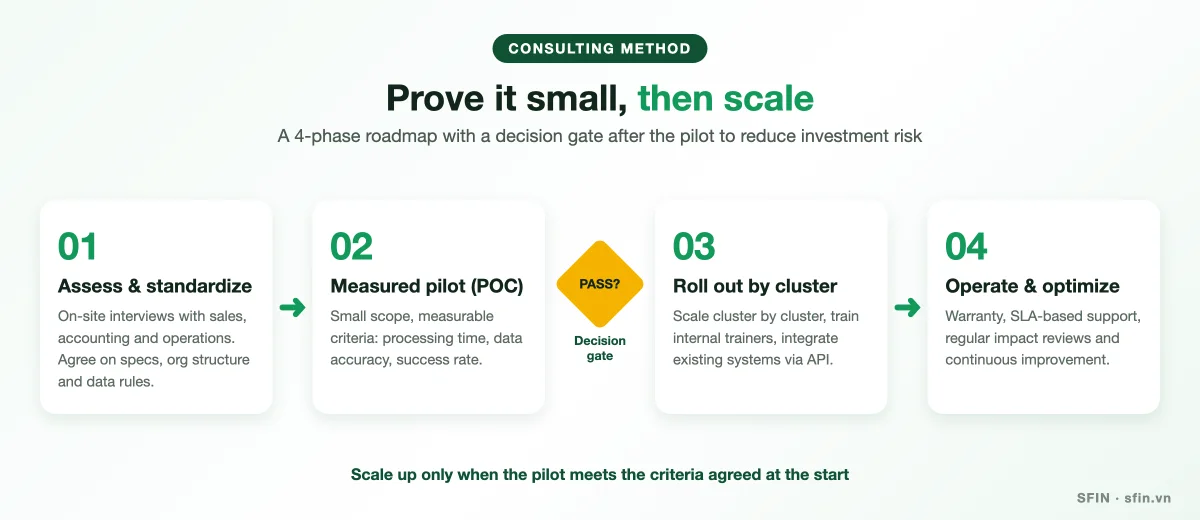
Phase 1 – Assess and standardize. On-site business assessment with both accounting and operations in the room. Agree on specifications, organizational structure, data rules, costing policies and reconciliation tolerances.
Phase 2 – Measured pilot (POC). Run at small scale against measurable criteria agreed up front. For a retail chain, for example:
- Time to process one order at the counter.
- Inventory accuracy after stock counts.
- Cost of goods matching the accountant’s manual calculation.
- Shift closing time and cash discrepancies.
- E-invoice issuance success rate.
- 100% of transactions synced after a network outage.
Decision gate. Scale up only when the pilot meets the agreed criteria. You never have to bet the entire budget up front.
Phase 3 – Roll out by cluster. Scale cluster by cluster and train internal trainers so the business can expand on its own.
Phase 4 – Operate, support and optimize. Support under a service level agreement (SLA), regular impact reviews and continuous improvement.
Proven capabilities
- 10+ digital platforms designed, built and operated by SFIN across multiple sectors.
- 5+ industries: financial services, retail, transport and logistics, telecommunications and business services.
- Vietnam’s largest retail chain: retail management platform with 11,000 outlets, 22,000 users and 4 management levels; 448 functional requirements met and fully traced to the specification.
- National-scale payment infrastructure organization: credit scoring and anomaly detection system processing around 35 million transactions per day.
“SFIN brought structure to processes that used to be fragmented. Their advice helped us redefine our priorities and make smarter, faster decisions.”
— Mr. Nguyen Van Sinh, Chairman, MOTA Group
Who is this service for?
- Retail, F&B and distribution chains that want to standardize operations across many outlets.
- Manufacturing and trading companies that need to connect sales, inventory and accounting.
- Banks and financial institutions modernizing systems and digitizing products.
- Businesses that have invested in software but are not getting value from it.
Frequently Asked Questions
How long does a digital transformation consulting project take?
The assessment phase usually takes a few weeks. The length of the pilot and rollout depends on the size of the business and is agreed in the roadmap from the start.
Do we have to abandon the systems we use today?
Not necessarily. SFIN assesses each system to keep, upgrade or replace it, and connects them through APIs.
How do we know the project is working?
Every phase has specific metrics agreed at the start. We only scale up when the pilot meets them.
How are consulting fees calculated?
Fees are flexible, based on your scope and goals, with transparent terms. SFIN sends a detailed proposal with investment options after the assessment session.
How to get started
- Business assessment at your actual workplace, with both accounting and operations present.
- Agree on scope and acceptance criteria for the pilot phase.
- Receive a detailed proposal with investment options.
- Hotline: (+84) 969 877 888
- Email: [email protected]
- Contact page: sfin.vn/contact
Read more: SOFIN E-commerce Ecosystem · Digital Payment & Fintech Solutions · Fintech in Vietnam: The Digital Financial Revolution
Digital Transformation Consulting
Need advice?
Hotline: (+84) 969 877 888
Email: [email protected]
Request for quote now!
Discuss your challenges and opportunities
Whether you’re exploring a challenge or ready for a full diagnosis — we’re here to listen. No bots — just a real expert ready to talk.