The Story of a New Generation
Picture this: You are 24, just out of university, and need a laptop to start your freelance career — priced at VND 20 million. You can comfortably pay VND 4 million per month, but not the full amount upfront. You do not want to go through the paperwork of a bank loan, you feel uncomfortable asking family for money, and traditional credit cards carry interest rates that do not make sense for your situation.
The solution? → BNPL — Buy Now, Pay Later
This is precisely what millions of young Vietnamese consumers need — and exactly why BNPL is the most powerful fintech wave of 2025–2026.
What Is BNPL? How Does the Technology Work?
BNPL (Buy Now, Pay Later) is a short-term consumer credit product that allows buyers to:
- ✅ Receive the product or service immediately
- ✅ Split payment into flexible installments (typically 3, 6, or 12 months)
- ✅ Get approved within minutes via AI-powered decisioning
- ✅ No collateral or extensive credit history required
The BNPL Flow: End-to-End
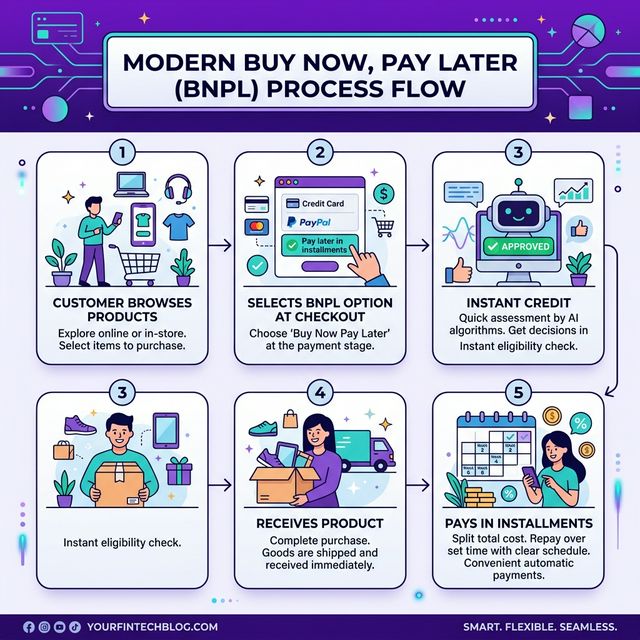
A seamless 5-step journey from product selection to installment completion
Step 1: Customer selects product online or in-store
Step 2: Chooses BNPL as payment method at checkout
Step 3: AI engine analyzes and approves credit in 30 seconds to 3 minutes
Step 4: Customer receives product immediately
Step 5: Automated installment deductions begin on the agreed schedule
P2P Lending: Financial Infrastructure Built by the People, for the People
While BNPL serves consumers, P2P Lending (Peer-to-Peer Lending) creates a direct marketplace between:
- 🏠 Borrowers: Individuals and small businesses seeking capital
- 💰 Lenders: Individuals with idle capital seeking yield above savings rates
The P2P platform acts as a technology intermediary — not a financial intermediary — enabling:
| Benefit for Borrowers | Benefit for Lenders |
|---|---|
| Lower interest rates vs traditional banks | Higher returns vs savings deposits |
| Streamlined digital application process | Diversified investment portfolio |
| No large collateral requirements | Transparent borrower information |
| Disbursement in 24–48 hours | Automated interest and principal collection |
Why BNPL and P2P Lending Are Exploding in Vietnam
Structural Market Drivers:
1. 23+ million “credit-invisible” consumers
Tens of millions of Vietnamese adults have no formal credit history and cannot qualify for traditional bank financing. BNPL and P2P markets create an entirely new credit access pathway — using alternative data rather than legacy credit scores.
2. Millennial and Gen Z consumers dominating spending
Adults aged 18–35 account for over 40% of total consumer spending in Vietnam — and this cohort overwhelmingly prefers digital-first, frictionless financial experiences that avoid branches and paperwork.
3. E-commerce’s exponential growth
Vietnam’s e-commerce market reached USD 25 billion in 2025, with BNPL rapidly becoming the default embedded payment option across major platforms.
4. AI-powered risk modeling outperforms legacy scoring
Rather than relying solely on traditional credit bureau data, modern AI systems can analyze hundreds of behavioral data signals to assess creditworthiness — more accurately and more equitably than legacy models.
FINBLUE: SFIN’s Integrated BNPL & P2P Lending Platform
FINBLUE represents SFIN’s primary product investment in the digital credit space — an integrated platform combining three next-generation financial instruments:
FINBLUE Ecosystem:
┌─────────────────────────────────────────────┐
│  💳 BNPL Consumer Credit                    │
│     - Zero-interest installment shopping    │
│     - 60-second approval engine             │
├─────────────────────────────────────────────┤
│  🤝 P2P Lending Marketplace                 │
│     - Direct borrower-lender matching       │
│     - Target yield: 8–15% per annum         │
├─────────────────────────────────────────────┤
│  📈 Investment Integration                  │
│     - Starting from VND 100,000             │
│     - Auto-diversified portfolio allocation │
└─────────────────────────────────────────────┘
Risk Awareness: What Users Need to Know
Responsible fintech means transparent risk communication. Key risks BNPL and P2P users should understand:
⚠️ User-Side Risks:
- Over-leveraging: BNPL’s accessibility can lead to spending beyond capacity if budgets are not tracked
- Late payment penalties: Some platforms impose high fees for missed payment deadlines
- Debt concentration risk: Stacking multiple BNPL obligations simultaneously can create cash flow stress
✅ How SFIN/FINBLUE Mitigates These:
- Automated credit threshold alerts and spending dashboards
- SMS and in-app payment reminders 3 days before due dates
- Transparent credit reporting to help users build verifiable financial histories
- Full compliance with State Bank of Vietnam regulatory requirements
BNPL 2.0: What Comes Next
The next generation of BNPL goes well beyond consumer goods:
- 🏥 Healthcare BNPL: Financing medical bills and dental procedures
- 🎓 Education BNPL: University tuition, professional certification programs
- 🏘️ Housing BNPL: Rental deposits, furniture and home improvement
- ✈️ Travel BNPL: Flights, hotels, and packaged tours
Conclusion
BNPL and P2P lending are not passing trends — they represent a fundamental restructuring of consumer credit infrastructure. For Vietnam, this is a once-in-a-generation opportunity to give millions of people equitable access to financial services while enabling businesses to dramatically expand their addressable market.
SFIN is at the forefront of this shift — not just as a technology provider, but as a genuine partner in building a more financially inclusive Vietnam.