
When Machines Understand Money Better Than Humans
In 2023, an AI-powered anomaly detection system at a major US financial institution identified a complex fraud scheme worth USD 2.3 billion — a pattern that a 200-person audit team had failed to detect over four years. This is not science fiction. It is the operating reality of modern financial infrastructure, and Vietnam’s fintech sector is rapidly catching up.
This article provides a technical exploration of how Artificial Intelligence (AI) and Machine Learning (ML) are redefining every layer of the financial stack — from real-time fraud detection and alternative credit underwriting to autonomous portfolio management and regulatory compliance automation.
5 High-Impact AI Applications in Fintech
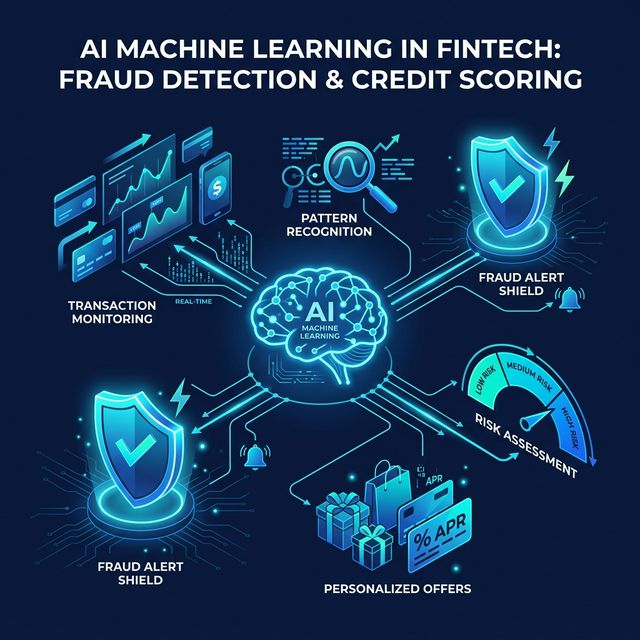
1. 🔍 Real-Time Fraud Detection
This is AI’s most mature and widely deployed application in financial services.
Production fraud detection systems analyze millions of transactions per second, identifying statistical anomalies across multiple feature dimensions:
- Geolocation vs. historical transaction origin
- Temporal patterns (transaction time relative to behavioral baseline)
- Amount deviation from rolling statistical norm
- Device fingerprint comparison against registered profiles
Technical outcome: Mean time to fraud detection reduced from 72 hours to < 300 milliseconds. False positive rates reduced by 60%, minimizing legitimate transaction blocks and improving customer experience.
2. 🎯 AI-Powered Alternative Credit Scoring
The legacy problem: Traditional credit models rely exclusively on credit bureau history, income documentation, and physical collateral — systematically excluding millions of “credit-invisible” individuals with no formal financial history.
The AI solution: Multi-feature alternative data models that ingest:
| Traditional Features | AI-Extended Features |
|---|---|
| Credit bureau score | Utility payment behavior (electricity, water) |
| Declared income | E-commerce spending patterns and consistency |
| Collateral valuation | App usage frequency and digital engagement |
| Employment record | Social graph and peer payment reputation |
The result: fairer credit decisions for underserved populations, with lower default rates than predicted by traditional models, validating the predictive power of behavioral signals.
3. 🤖 Robo-Advisors: Autonomous Portfolio Managemen
Robo-advisors are AI systems that autonomously:
- Profile investor risk tolerance via structured questionnaires and behavioral inference
- Construct optimized portfolios using Modern Portfolio Theory (MPT) and factor models
- Execute periodic automated rebalancing to maintain target allocation
- Apply tax-loss harvesting algorithms to optimize after-tax returns
4. 💬 Conversational AI and Virtual Financial Assistants
Next-generation financial chatbots extend well beyond balance inquiries. LLM-powered systems now support:
- Personalized financial planning: “Based on your income trajectory and spending patterns, I recommend allocating 15% of monthly income to an index ETF to achieve your 5-year savings target…”
- Predictive cash flow analysis: “Your account will experience a VND 2M shortfall during week 3 of next month based on recurring expense patterns.”
- Subscription audit: “You currently pay for 4 streaming services totaling VND 1.2M/month, of which 2 have not been accessed in 60 days.”
5. 📊 RegTech: AI-Driven Regulatory Compliance
AI is automating compliance workflows that traditionally required large operations teams:
- Automated KYC (Know Your Customer): Facial recognition + liveness detection completes identity verification in under 30 seconds, with accuracy rates exceeding 99.5%
- AML (Anti-Money Laundering): Graph neural networks detect complex layering and structuring patterns that evade rule-based systems
- Automated Regulatory Reporting: Structured audit trails and report generation aligned with FATF recommendations and SBV requirements — zero manual intervention
AI Architecture Within SFIN’s Product Stack
At SFIN, AI is not a marketing narrative — it is a core engineering layer embedded across every product:
🧠 FINBLUE AI Engine
- Alternative credit underwriting: Fuses traditional bureau data with behavioral signals to produce superior credit decisions with lower default rates
- Fraud Shield module: Real-time transaction scoring using gradient-boosted ML models with sub-100ms latency SLA
- Recommendation engine: Collaborative filtering-based product matching that surfaces relevant financial products at optimal moments in the user journey
🏪 SShop Intelligence Layer
- Cash flow forecasting for SMEs using LSTM time-series models trained on transaction history
- Anomaly detection for inventory and accounts receivable discrepancies
- Dynamic pricing suggestions using demand-elasticity modeling
Engineering Challenges and Honest Limitations
A technically rigorous discussion demands transparency about AI’s real-world constraints:
⚠️ Critical Engineering Challenges:
1. Training Data Bias
If historical training data reflects systemic discrimination (e.g., geographic credit redlining), the learned model will perpetuate those biases at machine scale. Continuous bias auditing using fairness metrics (demographic parity, equalized odds) is non-negotiable.
2. The Black Box Problem
Complex ensemble models (e.g., deep neural networks with 100M+ parameters) cannot explain individual decisions in human-interpretable terms — violating borrowers’ rights under legal frameworks like the EU AI Act and emerging SBV guidance.
3. Adversarial Attack Vulnerability
Sophisticated fraud actors actively probe ML model boundaries using adversarial examples — requiring continuous model retraining and ensemble defense strategies.
✅ SFIN’s Engineering Mitigations:
- Explainable AI (XAI): SHAP value decomposition for all credit decisions, enabling auditable, human-readable explanations
- PDPA compliance architecture: Privacy-preserving feature engineering with data minimization principles
- Quarterly bias audits: Statistical fairness testing across protected attributes before every model promotion to production
The Near-Future Roadmap: AI Fintech 2027+
Capabilities currently in research pipelines will fundamentally reshape the landscape within 2–3 years:
- LLM-native Financial Assistants: Domain-fine-tuned large language models providing GPT-4-level personalized financial advice at scale
- Federated Learning Deployments: Models trained across distributed device data without centralizing sensitive user information — enabling privacy-preserving personalization
- Quantum-Enhanced Optimization: Quantum annealing algorithms solving portfolio optimization problems that exceed classical computation feasibility
- Agentic Finance: Autonomous AI agents executing multi-step financial workflows (bill payment, investment execution, contract renewal) proactively on behalf of users
Conclusion: AI Does Not Replace Financial Professionals — It Augments Them
The most important takeaway for practitioners is this: AI in finance is not a displacement technology — it is an augmentation technology. It removes humans from repetitive, rule-bound tasks and redirects their attention toward:
- Higher-order judgment calls requiring contextual nuance
- Relationship-driven advisory services where trust matters most
- Ethical oversight of automated systems to ensure alignment with societal values
When AI and human expertise operate in concert — that is the true state of the art in fintech.
At SFIN, we are engineering that state of the art today, guided by our conviction: “Innovation for Life” — not innovation for its own sake, but innovation that creates tangible value for every Vietnamese user we serve.